Monday, October 8, 2012

San Francisco bound!

Due to my trip to San Francisco coming up very shortly, I wanted to post my write-up that I'll be presenting on at the American Public Health Association Conference on Monday, October 29th.  I appreciate all those who've supported me and continue to do so.  I hope all of you enjoy reading this as much as I have doing it.  Thank you!

Measuring Health through Awareness

By Jason D. Gillette

We can come to understand how   health is defined across cultures, populations and gender by altering how we measure awareness. This study is based on research which suggests that effective wellness programs can reduce absenteeism, sick time and improve productivity.  Wellness programs also make respective companies more attractive to future employees while reducing attrition for current staff.  Some of the most pressing issues in our society are disease and obesity.  We find the affects of these negative health outcomes far reaching and threatening across cultures, subgroups and socioeconomic stratifications.  

This research is designed to design wellness programs based on simple measurements  and to improve health awareness and implications in any community setting.  This program is low cost and yields modest improvements in overall health and health perceptions.

The objective of this study is to focus on accountability and education as the primary factors in stimulating positive health implication change.  We are held accountable in almost every aspect of our lives, whether it’s occupational, family, colleagues and/or friends.  Being held to some level of accountability is a natural occurrence and is healthy for those types of relationships.  This may help an individual excel, have higher standards or even help define what type of relationships they choose to manage.  
  
“The factor that interestingly moved their perception the most was the presence of high and consistent exercise minutes monthly.”

Two important characteristics which are not heavily used or considered with regards to improvement of a persons health, are accountability and perception.  These two aspects are vital in moving our society into a more health conscious state.  Accountability is key to finding success. By holding a participant answerable to the health information provided, we can see if they understand and/or applied the information.  

Perception is very important. It  gives the facilitator a window into the participant’s own interpretation of their health and well-being.  Their own interpretation can be compared to their anthropometrics and analyzed to see what factors drive their perception.  We’ve created a Nutritional Block Score (NBS Score) to assess a participants perception. This (3) block diagram measured their view of 1) nutrition, 2) body composition and 3) their level of fitness.  Participants were asked to choose a number between one and ten (one being poor and ten being excellent) for each category.  Once we’ve totaled these numbers, we divided them by the total number of blocks used, which gives us their NBS score.  

What we found was by gathering their anthropometrics and their own perception, we noticed correlations between high BMI and low (or poor) perceptions.  When a participants perception of their health is lower than (5) this is considered a low overall perception.  A low perception is defined as a negative perspective of a participants overall health.  The presence of high nutritional scores did not yield to high perceptions as we imagined it would initially.  The factor that interestingly moved their perception the most was the presence of high and consistent exercise minutes monthly.  We saw this consistently over all participants, even if their BMI was higher than normal weight.

Physical activity (PA) has been known to releases endorphins that alter our moods and energy levels.  This may be a key factor as to why we see positive perception change in participants with high exercise minutes.  We can see this being important, as it can help create better environments at work, school, communities and in our personal lives.  Another interesting occurrence was most female participants had significantly lower perceptions of themselves in comparison to their male counterparts, though their anthropometrics were respectably higher.  Reasons or possible causations for this occurrence were not researched further during this analysis.   

 In our time with Chicanos Por La Causa Senior Management and Executive Board Members, we discovered health was defined by facets that had little to do with biometrics and anthropometric results.  
Health included more dimensions than waist circumference and BMI.  How one perceived their energy levels, body composition and their family life seemed to affect their perception of their own health more.  One of the most important stats which seemed to be concomitant with their NBS score was the presence of exercise in each participant.  Exercise minutes most acutely had an impact on participants NBS score.  If one had low exercise minutes, their overall perception of their health was low. If the individual had respectably high exercise minutes, their NBS score reflected more positively.  

During this research program, exercise was not measured by level of intensity. This would suggest that any level of exercise would suffice in changing ones perception of their health.  This becomes all-important as varying ages and abilities can benefit from such a program.  This will aid individuals to create a more positive sense of wellness and self-worth.  Creating change in a participants lifestyle is important for weight-loss, and can reduce the likelihood of chronic disease.  Information was very influential in aiding the management team to start making changes to their overall health.  Once they were informed of how to make changes, and why, we could see improvement in dietary scores and NBS scores overall.  

My recommendation would be that the healthcare provider partnering with Chicanos Por La Causa implement a wellness program focused on creating sustainable exercise activities which promote employee or group interaction.  Holding all participants accountable by quarterly weigh-ins and monthly presentations will guarantee success, improve employee satisfaction and productivity.

In our findings, though the data is still being compiled; there is a close correlation between employees exercise minutes and increased health perceptions according to their NBS Score.  The data suggests that as little as 200 minutes per month improves our health perception 0.8 points on our NBS Score.  This is significant for the fact that our perception plays such a large role in how we manage our health and how we implement healthy living into our lives.  


Increasing our physical activity (PA) 200 minutes per month is as easy at walking for 20 minutes ten days a month, or exercising for 30 minutes more than six times a month. 
Our current objective will be to partner with Chicano Por La Causa’s healthcare provider to implement physical activity programs that will help us reach this goal and monitor the increase through further research.  The level of accountability played a large role in seeing increase in how participants reacted to the information provided.  This helped all active participants to maintain or experience moderate weight loss.  Through accountability, participants also increased exercise minutes, thus showing increases in their NBS Score over the year.  

Sunday, October 7, 2012

How to think of what we think...


When someone asks us, how we're doing? What comes to mind? Some may associate this question with either social, physical or mental health.  May we measure the current level of pain we are experiencing? Do we look at our personal circumstances, or the circumstances that are to come? Or do we think of our recent doctors visit, or the last time we went to the gym or an exercise class to answer that question? Whatever the case, we all have to base our answer to that question on something that directly affects us. Well, when we look at ALL the factors that could cross our mind when answering such a simple question, one thing is for sure, whatever the facet that forms our answer is important and an indicator to how we perceive our health. 

When we look at the presence of biomedicine in our society we tend to have a very linear way of thinking about it. Get sick, take meds, rest; if the problem persists go to the doctor. This has been the case for some time. When looking at traditional medicine we find that remedies differ from circumstance, culture and area. These aspects of medicine shape our idea of health and illness. Our perception can be easily swayed. If something works then it becomes a remedy and we find a way to frame it into our health concept. 

I say all this to frame the idea that our perception is just as important as the treatment or measures taken to bring us back to wellness. As a matter of fact, our perception shapes how we look at the treatment or how we address our health. For instance, having stress due to problems on the job may cause us to think negatively about our health, even if there are not physical or biometric signs of fatigue or stress. To take it a step further, we see instances when participants rate their health poorly based on the health of their family overall. This I find fascinating, community health affecting an individuals own perception of their health. Surprisingly, this is very common. How we define our health often affects how we manage our health. Having a varying perception of our health or an external impact effect, can modify how we feel internally. Thus, making choices on how to remedy the event, administer care or when to seek care could differ. 

The image you see here is an NBS Score or (Nutritional Block Score) this tool helps me get a small view into a persons own perception of their health. This when compared to their biometrics (blood pressure, cholesterol, glucose, etc) and anthropometrics (BMI, weight, waist circumference, body fat, etc) we see distinct differences between the three. Often times the NBS Score is noticeably lower in comparison than the two. Our perception is often affected by facets outside of the biometrics and anthropometrics. Understanding what that may be is where I came in. 

When trying to understand health perception and develop a wellness program that was effective, I found many obstacles. I developed a way to measure how exercise, education and accountability improved the overall health of the participants. Creating the NBS Score, helped me to see what factors improved their perceptions the most. What was more fascinating than the components that positively changed their perception, was what altered their thinking or awareness in the first place. 

Our view of what defines health is important, it can aid us in making good or bad choices regarding our overall wellness. Being mindful of how we think of ourselves and understanding that health without accurate awareness can be destructive. We as a whole can be better informed and manage our health in a much more effective way. Defining health in a way that we as individuals can identify with and apply, is the next ystep in building a more health conscious society.


Monday, September 10, 2012

What does it take to blossom? (Part 5)

As we have talked about plants in the previous (4) installments, we've come to understand dynamic aspects of plant life and how amazing they really are.  More importantly, we can see how amazing we CAN be if we take the time to apply simple realities that a plant acts upon everyday.  In order to grow as a person we need to know where we are at the moment of change.  This growth is necessary, though, many choose not to grow.  We all want to be the best us we can, but we need direction and guidance.  Looking at a plant rather than another person, helps us to understand that we need not imitate someone's personality, viewpoints or habits.  All we need to do is put our highest quality out in front of us. Though no one is perfect, it is important that we understand that our best is measured not by men or tests, or even our own perception, but by the level of good that exude from our best efforts.        


We cannot do it alone
What we emit from us does affect others (we'll touch on that next time).  Our greatness or our best can be experienced by those we touch around us.  Having this thought in mind, if our best affects those around us, can those around us affect our best?  Well the answer is yes, they can!  This is all important as we go into the world, doing our best to define ourselves and affect the things we encounter.  Just as high levels of smog can affect our air quality and breathing, poor association can do the same.  Likewise, good people, experienced people that contribute to our lives can bring meaningful insight into our world, causing us to refine ourselves. 


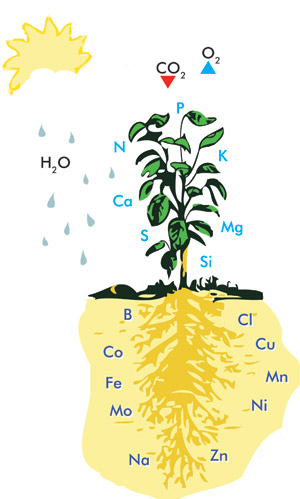
In this part of how to blossom we will look at external nutrients that a plant needs to do all the things we've discussed previous.  To peer into the simplicity of a plant may seem trivial or insignificant; but only to the one not willing to see and understand the mastery of such a complex creature. The flower is something to marvel at, it has been the object of paintings, poetry, dreams (you go Freud!), politics and symbols of peace to name a few.  How has this small, light and delicate plant gain so much attention, without saying a single word?  A flowers beauty and contours; its colors and uniqueness has beckoned for our respect and admiration for centuries.  However, all of this wouldn't be up for discussion without external nutrients that affords it to grow, and evolve into what we appreciate today.  

When we think of the (3) things that plants need that they cannot provide for themselves, what comes to mind is simple.  Most second or third graders could tell you these components.  The first is the sun, then water, and lastly air, namely carbon dioxide.  These three parts are essential for a plants growth and sustainability.  So, we can see why they are so important.  Well, what about us?  What can we take from this, well, just as a plant needs these things so do we.  We need external nutrients to survive and sustain our own growth.  

If we observe how the sun affects a flower we can see the diaphanous line between helpful and harmful.  The suns warmth can be monumental in aiding a young or fragile flower reach its maturity.  In that same breathe we can see that too much sun can also be fatal.  I liken this to family, family can be extremely helpful, but also can prove to deal fatally with us and our growth.  The balance needs to be the goal in our family relationship, we need our family, there isn't any arguing that, however, we need them to the extent that they prove to be helpful.  

The next external nutrient that we absolutely need is the refreshing and priceless source of  water.  Without this everything we know to exist would not be.  That is how vital water is to a plant and also to us.  Our water is relative to our experiences.  This aspect of those external nutrients is essential to our growth.  Though our experiences are ours alone, they are external first before we take ownership of them.  This is important as it is HOW we take ownership of our experiences that is important.  The reason being that this could either damage us or aid in our growth.  Just the way we perceive things can have an affect on us.  This is an external source that becomes ours by our being present in the moment.  

The third part is also very important, this one is the oxygen around us.  Though we cannot see the air around us, we can immediately identify it's significance by what it brings us.  This, I also liken  to our friends, or mentors; one can see externally who is your friend or mentor, but they can be identified by what they bring to us.  Our friends just like oxygen can refresh us and give us the necessary components we need to continue to thrive.  In this case we are namely speaking of carbon dioxide, and this is important to note, for the fact that this is the used air that is needed for our growth.  I like to compare this term "used" to experienced, just as carbon dioxide is "experienced" oxygen.  Those we should surround ourselves with should be experienced, able to help us and bring to us what we need to grow.  

What can all this do?  Well, it can prepare us to give our best.  Which will be proven by what it does to others.  A heart is measured only by its production or output, no matter what the condition, as long as its delivers on its purpose it's consider successful.  By having external nutrients we can grow to heights unimaginable.  Let our sun warm us, let our water refresh us and let our air prepare us.  

Friday, August 31, 2012

It's Heart to deal with...

We cannot play games with OUR heart...
Stress is an unseen opponent, that has targeted all of us.  When we talk about how powerful the mind is, we can't ignore that, that power can work both ways.  How can we sabotage ourselves mentally?  In the same way, we can sabotage ourselves physically, by allowing uninformed, and undisciplined actions determine who we are and what we do.  The mind we have is a fascinating machine, making over thirty thousand decisions a day.  Some small some major, all ours.  Defining ourselves and redefining ourselves requires that we be mentally focused and engaged at a high level.  We need to be present and attentive to ourselves and our surroundings.  That unseen opponent ironically has no voice, yet dictates our lives, health and abilities.  

Stress affects all aspects of our lives.  This is evident as more and more cases of stroke and cardio-vascular disease occur in the United States and other parts of the world.  So what is stress? "Stress is a normal physical response to events that make you feel threatened or upset your balance in some way. When you sense danger – whether it’s real or imagined – the body's defenses kick into high gear in a rapid, automatic process known as the “fight-or-flight” reaction, or the stress response." (helpguide.org) The idea that the danger or stressor could be imagined is the key.  Though most occurrences are real, our minds can create others.  Having said that can our mind heighten perceived dangers to cause higher levels of stress?  

In a research article in the Journal of Neurology Neurosurgery and Psychiatry in Great Britain, we found that stress has accounted for heart disease, which kills more Americans than any other disease.  What the article brings out that is interesting is that certain personalities and behaviors can trigger stressors that cause stroke.  When we see "...Behaviors that include hostility, agression, impatience and a quick temper", we can associate them with type A personalities.  I find it interesting that these traits are all responses to circumstances.  They often don't act independently of a event or incident.  Which we can also associate with a perception or viewpoint of a certain matter.  For instance, if someone said, "I don't understand you", we could internalize that and feel threatened (hostile) or offended (agression) that someone is challenging our level of intelligence or communication skills.  Rather, we could look to clarify what they meant and reiterate in a way that works for them.  Our understanding of some situations and our ability to manage them affect our stress levels.  

If you ever get a chance, read the old Chinese proverb (one of my absolute favorites), as this helps me put things into perspective on a lot of things in my life.  Do not let stress damage the wonderful person you are, and affect how we connect with others.  Please do not misunderstand me, stress is real and can have very serious affects on our physical and mental health.  Some aspects of stress can lead to depression and other serious psychological maladies.  

In this blog, we want to understand that we can create harmful circumstances for ourselves by interpreting matters in a negative light and furthermore affect our own growth.  Cognitive plyometrics is the ability to have the fitness mentally to engage our situations with the intent to understand and think critically on how to resolve them with the least resistance.  

As life gives us situations that we feel we are not equipped for, let us understand that though we may not have the answer at that exact moment we can find solace in the fact that patience and focus will lead to an answer eventually.  We are far to special and significant to allow stressors to abuse our thoughts and our body.  Stress exists in midst of unresolved problems.  We need to devote ourselves to finding answers or contingencies to alleviate the stressors and bring ourselves back to normal.  

We are wonderful, you are wonderful.  We can find our peace in anything if we want, all we need is focus and active planning to create an environment conducive to problem solving.  Our friends and family can act as our extra support through most situations.  Utilize them to aid you in finding resolutions.  Remember, "We will never be, what we never think." MG

Tuesday, July 24, 2012

Happy Anniversary MOTM!

Happy anniversary Movement of the Mind, I want to thank all who've taken the time to peer into my thoughts.  I do hope all have had the chance to learn and/or enjoy this blog.  I have had so much fun writing it and look forward to another year of more thought provoking information.  Remember, cognitive plyometrics is really designed to help all of us reach a level of critical thinking that can aid us in becoming more valuable and refined.  My hat goes off to all who want to be better and always see the room for growth.  Life is a journey, and we all need help along the way.  Thank you, everyone for making this such a success, I cannot tell you how much I enjoy writing this blog.  Thanks!

Monday, July 23, 2012

Who is Food?


So, they tagged along with me on this trip, helping me the whole way.  I never felt alone, plus, they have the sweetest sense of humor.  I laughed, and contemplated so many things during this trip.  I cannot imagine having to go all the way here without them.  The connection made was almost as if we were designed to feed off one another.  Our personalities melded and they complimented me in so many ways.  I became the very existence of them and they, my lifeline.  I never could have imagined such unbiased, non critical, understanding and comforting friends.  When I'm upset they're there, and even when I'm celebrating key moments in my life, within arms reach I could see them peering at me with acceptance.  They give me energy to continue, and even help me find rest.  I never get tired of their company, even when I just want to be alone.  When life holds me to so many expectations, I am never judged, or held to any standards with them.  On my bad hair days, bad mornings and sometimes less than glamorous physique they always welcome me.

Can food be given life? 
Can we identify with this story?  If so, we are but a few of billions of people who exist and have a relationship with the food we eat.  The idea is that food is taking on a more prominent role in our lives, whether we know it or not.  Food gives us energy, yes, that's its basic function, however, now it does much more.  It creates relationships, calms, inspires, pleases, comforts, nourishes and the list could continue.  In the society we live in here in America, obesity is no more than a way of life.  The scary word, "epidemic" has lost its sting as obesity has rolled over it and moved on.  The reason I believe this to be the case is, we are addressing the behavior of those who are obese and not so much the relationships they sustain.  Whether, emotional eating, external eating or restrained, the relationship is most consistent and alive.  We'd do well to understand how individuals view food and how they interact with it.  The old mantra of "Energy in" is antiquated.  People are looking to this food relationship for answers and comfort circles, unknown elsewhere.  

You are what you eat, seems to still circulate throughout our culture.  When asked, a young lady who uses food as comfort, due to a lack of social interaction said, "I eat when I'm sad, because I have no one to speak with.  Food is my friend that accepts me for who I am, never judging and always there in my most quiet spaces."  Does this sound like food or a friend?  A relationship with food exist between all of us, how we manage that relationship will define a aspect of our health and diet.  

Portion control could be likened to a unbalanced relationship where we may want, or be wanted more than necessary.  Poor diet, also could be viewed as making poor choices in friends, where common sense or foresight is absent.  Restrained eating could also look like self deprivation or avoidance, which once that emotion or stint is over, we find ourselves on the other end of the spectrum.  These may help us to see that food could be a foe, though unbiased, or unconditionally accepting.  

Can our society rich with technology, be feeding this issue?  Well, here's a thought, with the presence of technology, we see a decrease in human interaction, thus social experiences could involve just one human being alone.  Can our friends be food, just as much as an online avatar or television program?

We are creatures designed to interact with one another.  We need relationships, and not everyone has the right circumstances to create healthy ones.  This is why education is vital, we need resources for those who need to reach out and get connected.  We cannot do this life alone, so one way or another we'll find someone, or something to accompany us.

Tuesday, July 10, 2012

What does it take to blossom? (Part 4)

In this piece we will discuss the ability to again redefine ourselves and reach a level of understanding that can truly separate us.  This blog bases its message on cognitive plyometrics which simply put is our ability to think actively and with agile insight.  Conditioning the mind is superior and primary to the body thus giving us the ability to do all that is needed to accomplish much in our respective worlds.  Our minds are stronger than our body, so focusing on cognitive development is far more challenging and also more rewarding.  

Our roots should be greater than us
This piece that is in its fourth part is delving into the roots of a plant.  Looking at the a flower (or most plants for that matter) what we don't see plays a vital role in its survival.  A plant just like our mind blossoms forth giving a byproduct that can be seen, admired and appreciated by many.  Our minds give forth ideas, plans, words and most of all actions that differentiate us and also makes us special.  Just like that flower beneath the beautiful blossomed bud, its vibrant leaves and stem, exists a system or network of roots that stretch far and deep to provide the most important nutrients that, that plant needs to give us such a wonderful flower.  

In this article we will discuss the roots as an important aspect of blossoming.  There are (4) pieces that the roots play that we will delve into.  The first being survival!  Just as a plant needs roots to survive we also need proverbial roots.  Our figurative roots are our support, our life lines (as it were).  Our survival depends on our ability to reach out and also dig deep within us to develop ourselves.  Reaching out when developing ourselves is essential.  Do we have mentors, friends who are moving in the same direction, and supportive family to give us our nutrient, whatever that may be when we need it?  Can a plant survive without roots?  Likely, we cannot grow either without support and direction.  This means our very survival, having those around us to refine us and direct us to be better.  

Next on our list is strength, the roots of a plant burrow deep in the earth to not only obtain the soils best nutrients. It also provides stability for the plant to maintain its place.  So, does our support keep us grounded to our place in life, aiding us to be ever determined not to sway towards poor thinking or bad judgement.  The more nutrients required by the plant the stronger and deeper the roots.  Digging deep within ourselves and demanding more of us strengthens our thoughts, plans and actions.  The strength of our roots will only sustains us and keep us grounded in sound thought.  The idea that iron sharpens iron, lends to the idea that just for as much as you are sharpened you need to return the favor, thus being equally strong with those who refine you.  This takes time, but is very important.  

Spreading out and having deep roots speaks more to our thoughts than our respective support system.  Our thoughts need to have a fair measure of depth, we cannot be surface (all the time).  Life requires more of us and rightfully so, if we cannot give of ourselves to a large degree, than we may not be able to grow.  Think of it this way, a tree gives of itself tirelessly in order for it to grow.  It gives us oxygen in order to receive the carbon dioxide it needs to grow.  It also supplies a home for wildlife and protection.  It provides meals and shade for both human and animal alike.  Trees also provide mulch once its life span has ended to give yet another tree the opportunity to live.  We have to be givers in both deed and thought, contributing to our respective circles relevant and valuable information that strengthens and replenishes.  Giving all the more, guarantees us our growth.  

Lastly, could you imagine a flower having only one root?  The very idea seems silly if you think about it.  Likewise, having little or no support would seem also unwise.  Or even having one thought, or concept?  This too is futile and hindering.  Branch out all you who want to grow, do not find all your company with those who think just as you do in regards to your development.  Look at contrasting ideas to affirm your own or think differently on a matter, thus adding a new root that can give you the nutrients needed to grow.  This article is not suggesting you befriend everyone, no, this is a call to find productive, refining support.  Develop and sustain numerous thoughts, both deep and not so deep that challenge and engage you.  This will give us the best chance to grow.   

What does it take to blossom?  Strong roots deep in ourselves and in others.  Thinking that is far reaching from our own ideals, to those who may not think as we do.  If the simplest flower can find success doing this, surely we can.